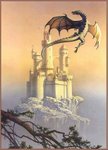

Jack continued his journey, and fell in before long with the son of King Arthur, who had come into Wales to deliver a lovely lady from a magician who held her captive. Jack offered his services and the prince was glad, of course, to accept them.
They came to the castle of a giant who had three heads, and by his own account could whip five hundred men. Jack told the prince to stay behind while he went to ask for lodging. He knocked loudly and the giant roared: "Who is there?" "Only your cousin Jack come with news," was the reply.
The giant, as Jack happened to know, had, so many cousins that he could not keep track of them, so he said: "Well, what news cousin Jack?" "Dreadful news, dear cousin," said Jack. "King Arthur is coming with ten thousand men to kill you."
The giant was really an awful coward; and, if he did have three heads, was not gifted with very much brains. When he heard this news he trembled so that his heads began to knock one another very hard, at which Jack could scarcely help laughing in his face-I should say in his faces.
"Oh dear! Oh dear! What shall I do?" said the giant. "I'll go and hide in the cellar until they are gone. Here are my key-cousin. Lock me in, and let me know when it is safe to come out.'
So off he went to hide, and Jack, after he had locked him up, led the prince in. They stayed all night, and in the morning Jack opened the giant's treasure-room, and helped the prince to a good share of the treasure, after which he started him on his way. Then he went and told his "cousin" that the coast was clear, and took great credit to himself for helping him to escape. The giant was very grateful, and told Jack that he would give him something precious for a reward. He brought forth a coat, a sword, and a pair of shoes, and said: "When you put on the coat no one can so you, the sword will cut through anything, and with the shoes you can run with the speed of the wind."
With the help of these useful articles, Jack and the prince soon found the magician, and overcame him, and set the lady free. The prince led her to his father's court, where he married her; while Jack, for his gallantry, was made a Knight of the Round Table.
But Jack would not be idle while there were any giants left; so be soon set out once more to do battle against them. One day as he passed through a wood he saw a giant dragging a knight and a handsome lady along by their hair. Jack put on his magic coat of darkness, and drawing his sword of sharpness, thrust it into the giant's leg, and gave him such a wound that he fell to the ground, upon which Jack cut his great ugly head off.
The knight and his lady invited Jack to their castle, but he said that before he went he wished to see the giant's den.
"Oh do not go near it!" said the lady. "He has a brother there fiercer and stronger than himself."
But this only made Jack more determined to go. He found the cave easily enough, for the giant was sitting at the mouth of it, with a great spiked club in his hands. Jack ran up and gave him a stab with his sword. The giant could see nobody, but began laying blows all about with his club. Jack easily kept out of the way, and, meanwhile, continued slashing him with his sword until he killed him. Then he cut off his head, and sent it along with his brother's to the king, in a wagon--and a good big wagon-load they made.
rip van winkle picture story
Then Jack went to the castle of the knight and the lady. While he was there the news came that Thundel, a savage giant, and a cousin of the two others, was coming to avenge their deaths. Everyone except Jack was filled with terror. He assured them that he would dispose of Thundel, and gave orders that the drawbridge over the moat around the castle should be sawn nearly through, so that it would barely stand, and that a rope with a loop at the end should be made ready. Then, after putting on his shoes of swiftness, he went out to meet the giant. As soon as he came within hearing, Jack began to taunt him, and when the giant started in chase, he ran back to the castle and over the drawbridge, which remained strong enough to support his light weight. But when the giant followed, it crashed beneath him, and down he went in the water. As soon as his head bobbed up, Jack threw the loop of the rope over it, and drew him to the bank and cut his head off.
After spending a few days with the knight and his lady, Jack set out again. He met with an old hermit who told him of a giant named Galligantus, who lived on a hill near by, and whose destruction would be a task worthy of him.
"He is a magician," said he, "and always goes about with a great owl on his shoulder. He has an enchanted castle, in which he holds captive a number of knights and ladies, whom, by his magic, he has turned into beasts. The means of breaking the enchantment is engraved on the inner doorway of the castle, and may be read by anyone who can pass the outer gates; but these are guarded by two griffins who dart fire from their mouths, and have destroyed all the brave knights who have yet tried to enter. But with your coat of darkness you can safely pass them, and once in, you will easily manage the rest.
Jack promised to do his best, and started the next morning for the top of the mountain. There he saw the two fiery griffins, but as he had on his magical coat he passed between them unhurt. Then he came to the inner doorway, where hung a golden trumpet, under which was written:
"Whoever can this trumpet blow
Shall cause the giant's overthrow."
Jack seized it and blew with all his might. It rung out loud and clear, and the doors flew open with a crash. The giant ran trembling to hide when he heard the trumpet, knowing that his enchantments would no longer avail him. But Jack found him, and with his sword of sharpness quickly put an end to him. The captives were all changed back to their own shapes when the trumpet sounded, and now Jack went through the castle and set them free. Among them there was a beautiful young lady, the daughter of a duke, and Jack thought he would see her safely to her father's castle. Upon the way he fell deeply in love with her; and finding that she returned his affection, he asked her father's consent to their marriage, and it was given. King Arthur, for his great services, made him a baron, and gave him estates and a castle, in which he and his fair wife lived long in content and happiness.
Thursday, May 24, 2007


Jack the Giant Killer (part1)
IN the days when King Arthur ruled in Britain, there were many giants in the land--huge, fierce monsters, who kept folks in constant terror. It was at this time that our hero, Jack, was born. He grew up a brave, fearless, little fellow; and before he was ten years old, he had made up his mind to gain a name for himself by ridding the land of some of the giants.giant killer picture story of jack
Of all those in Jack's part of the country, no giant was dreaded more than one named Cormoran, who dwelt on a hill called St. Michael's Mount, which rises out of the sea near the coast of Cornwall. He was so tall that when the tide was low, he could walk through the sea from his cave over to Cornwall, and this he did quite often--never going back without carrying along some poor farmer's cattle or sheep.
Jack set his wits to work, and at last thought he had a plan by which he would be able to put an end to the misdeeds of this monster. He took, one evening, a pickaxe and shovel, a lantern, and a horn, and getting on a raft, paddled over to St. Michael's Mount. He went to work at once and dug a deep pit in front of the giant's cave. Next he placed sticks across the top of the pit, and on the sticks spread straw, while over the straw he strewed loose earth until all looked like solid ground.
By this time day had dawned; so Jack stepped back a short distance, and blew a loud blast upon his horn. It awaked Cormoran, who came out to see what it meant, and when he beheld Jack was in a great rage.
"You saucy little imp," said he "just wait a moment, and I'll broil you for my breakfast."
With this he came running to catch Jack; but the pit was right in his way, and the instant he set foot on the earth covering it, the sticks broke, and down he crashed, over his head into it.
"There, Mr. Cormoran," said Jack, "you see it is sometimes a bad thing to be in too much of a hurry for your breakfast."
At this the giant began to make frantic efforts to climb out, so Jack ran up with his pickaxe and gave him a blow on the head which killed him.Jack the giant killer, fairy tale picture
Jack returned home, and when the news spread of what he had done, the people were full of joy, and made a great hero of Jack, giving him the title of JACK THE GIANT KILLER; while the Duke of Cornwall made him a present of a sword and belt, upon which, in golden letters, were the words:--
"This is the gallant Cornish man
Who slew the Giant Cormoran."
But this only made Jack crave for more glory; so he started for Wales, where the number of giants was very great indeed. One day, as night fell, he came to a fine large house where he thought he would ask for lodgings. He knocked at the door, and was startled when a giant with two heads came to answer. He was civil, however, and asked Jack in, and gave him his supper and a bed; but Jack did not trust him altogether, and made up his mind not to go to sleep. The giant seemed to have a habit of talking to himself--as would be natural to one having two heads--and presently he began to sing a kind of duet, some of which Jack was able to make out. First, one head sang, in a soft tenor voice:
"Although with me he stays this night,
He shall not see the morning light."
And then the other head growled, in a deep bass:
"For as he lies asleep in bed,
With my trusty club I'll smash his head."
"Oho!" said Jack, "that's your game is it, Mr. Giant? Now for a plan to fool you."
Jack thought a moment, and then went to the fire-place, where he found a log of wood. He put this in his place in the bed, covered it up well, and then crawled under the bed.
In the middle of the night the giant stole into the room with a club in his hands. Drawing near the bed, he raised the club and gave the log of wood a number of terrible whacks. Then, thinking Jack must surely be dead, he went away.
When Jack appeared in the morning, without a sign of hurt upon him, the giant could hardly believe his eyes.
"How did you sleep?" he asked. "Did anything disturb you during the night?"
"Oh, at one time I thought I felt a rat switch me with his tail," said Jack, "but for the rest, I slept very soundly."
The giant went to get breakfast ready; and while he was away Jack caught sight of a leather bag in a corner of the room. He thought of another trick to play on the giant; so he put the bag under his coat, which was quite loose. The giant brought in two big bowls of porridge, to which he and Jack sat down. The giant took a spoon in each hand, and began to feed both mouths at once, which made his porridge go pretty fast; but not any faster than Jack's did, for he was stowing his away in the bag. The giant was so busy feeding that he did not take much notice of Jack until he had finished his bowl, when he looked up and was greatly surprised to find that the little fellow had emptied his also. While he was still wondering, Jack said:--
"Now I'll show you something strange. I can cut off my head or legs, or any other part of my body, and put them on again a good as ever. Just see this, for instance." And he took a knife and cut the bag, so that all the porridge tumbled out on the floor.
The giant's conceit had already been very much hurt as being outdone by such a little chap as Jack, and now he lost his wits completely. "Ods splutter my nails," said he, "I can do that myself." So he took the knife, and stuck it in where his porridge was--and dropped dead on the floor.
Of all those in Jack's part of the country, no giant was dreaded more than one named Cormoran, who dwelt on a hill called St. Michael's Mount, which rises out of the sea near the coast of Cornwall. He was so tall that when the tide was low, he could walk through the sea from his cave over to Cornwall, and this he did quite often--never going back without carrying along some poor farmer's cattle or sheep.
Jack set his wits to work, and at last thought he had a plan by which he would be able to put an end to the misdeeds of this monster. He took, one evening, a pickaxe and shovel, a lantern, and a horn, and getting on a raft, paddled over to St. Michael's Mount. He went to work at once and dug a deep pit in front of the giant's cave. Next he placed sticks across the top of the pit, and on the sticks spread straw, while over the straw he strewed loose earth until all looked like solid ground.
By this time day had dawned; so Jack stepped back a short distance, and blew a loud blast upon his horn. It awaked Cormoran, who came out to see what it meant, and when he beheld Jack was in a great rage.
"You saucy little imp," said he "just wait a moment, and I'll broil you for my breakfast."
With this he came running to catch Jack; but the pit was right in his way, and the instant he set foot on the earth covering it, the sticks broke, and down he crashed, over his head into it.
"There, Mr. Cormoran," said Jack, "you see it is sometimes a bad thing to be in too much of a hurry for your breakfast."
At this the giant began to make frantic efforts to climb out, so Jack ran up with his pickaxe and gave him a blow on the head which killed him.Jack the giant killer, fairy tale picture
Jack returned home, and when the news spread of what he had done, the people were full of joy, and made a great hero of Jack, giving him the title of JACK THE GIANT KILLER; while the Duke of Cornwall made him a present of a sword and belt, upon which, in golden letters, were the words:--
"This is the gallant Cornish man
Who slew the Giant Cormoran."
But this only made Jack crave for more glory; so he started for Wales, where the number of giants was very great indeed. One day, as night fell, he came to a fine large house where he thought he would ask for lodgings. He knocked at the door, and was startled when a giant with two heads came to answer. He was civil, however, and asked Jack in, and gave him his supper and a bed; but Jack did not trust him altogether, and made up his mind not to go to sleep. The giant seemed to have a habit of talking to himself--as would be natural to one having two heads--and presently he began to sing a kind of duet, some of which Jack was able to make out. First, one head sang, in a soft tenor voice:
"Although with me he stays this night,
He shall not see the morning light."
And then the other head growled, in a deep bass:
"For as he lies asleep in bed,
With my trusty club I'll smash his head."
"Oho!" said Jack, "that's your game is it, Mr. Giant? Now for a plan to fool you."
Jack thought a moment, and then went to the fire-place, where he found a log of wood. He put this in his place in the bed, covered it up well, and then crawled under the bed.
In the middle of the night the giant stole into the room with a club in his hands. Drawing near the bed, he raised the club and gave the log of wood a number of terrible whacks. Then, thinking Jack must surely be dead, he went away.
When Jack appeared in the morning, without a sign of hurt upon him, the giant could hardly believe his eyes.
"How did you sleep?" he asked. "Did anything disturb you during the night?"
"Oh, at one time I thought I felt a rat switch me with his tail," said Jack, "but for the rest, I slept very soundly."
The giant went to get breakfast ready; and while he was away Jack caught sight of a leather bag in a corner of the room. He thought of another trick to play on the giant; so he put the bag under his coat, which was quite loose. The giant brought in two big bowls of porridge, to which he and Jack sat down. The giant took a spoon in each hand, and began to feed both mouths at once, which made his porridge go pretty fast; but not any faster than Jack's did, for he was stowing his away in the bag. The giant was so busy feeding that he did not take much notice of Jack until he had finished his bowl, when he looked up and was greatly surprised to find that the little fellow had emptied his also. While he was still wondering, Jack said:--
"Now I'll show you something strange. I can cut off my head or legs, or any other part of my body, and put them on again a good as ever. Just see this, for instance." And he took a knife and cut the bag, so that all the porridge tumbled out on the floor.
The giant's conceit had already been very much hurt as being outdone by such a little chap as Jack, and now he lost his wits completely. "Ods splutter my nails," said he, "I can do that myself." So he took the knife, and stuck it in where his porridge was--and dropped dead on the floor.
The Story of Robinson Crusoe (part2)
Thus years and years passed away. Although I had, to some extent, become contented with my solitary lot, yet at times a terrible sense of loneliness and desolation would come over me. Many times I would go to the top of a hill where I could look out to sea in hopes of catching sight of a ship. Then I would fancy that, at a vast distance, I spied a sail. I would please myself with the hopes of it, and after looking at it steadily, till I was almost blind, would lose it quite, and sit down and weep like a child, and thus increase my misery by my folly.robinson crusoe island picture, adventure story
But one day I saw a sight which turned my thoughts in a new channel. It was the print of a naked foot upon the sand near the shore. It filled me with fear, for it showed that the island must sometimes be visited by savages.
One morning, going out quite early, I could see the light of a fire about two miles away. I went to the top of the hill and looked in the direction of the fire. I saw that five canoes were drawn up on the shore, while a swarm of naked savages were dancing about the fire. Presently they dragged two poor wretches from the boats. One of them was knocked down at once, and several of the savages set to work to cut him up. They were evidently cannibals, and were going to hold one of their horrible feasts on their captives. The other captive was left standing for a moment, and seeing a chance to escape, started to run. I was greatly alarmed when I saw that he was coming directly toward me, but when I saw that only two pursued him, and that he gained upon them, I made up my mind to help him. When they were near enough, I took a short eut down the hill, and placed myself between pursuers and pursued. Then I advanced on the foremost, and knocked him down with the stock of my gun. The other took his bow and was going to shoot me, when I fired at him and killed him. Then I made signs to the poor runaway to come to me, and he did so in fear and trembling, kneeling at my feet and setting my foot upon his head, as a sign that he was my slave.
I had now a companion, and in a short time I began to teach him to speak to me. First I let him know that his name was to be Friday, for that was the day I saved his life. Then I taught him everything that I thought would make him useful, handy, and helpful. I clothed him in a suit made of goatskins, and he seemed to be greatly pleased to be dressed like myself.
After some time had passed over, Friday came running to me one morning to say that there was a ship in sight. Welcome as this news was, I thought I would not show myself until I could learn what had brought the ship there, and it was well that I did not. I watched in concealment and saw a boat leave the ship and make for the shore. Eleven men landed, and I saw that three of them were bound as captives. They were laid upon the ground while the rest dispersed about therobinson crusoe adventure picture island. I approached the captives and questioned them, and found they were English, that one was the captain, and the others were the mate and a passenger, and that there had been a mutiny on the ship, and that the men, as a favor, instead of killing them, were going to leave them on the island.
I offered to aid them to recover the ship, and going back to the castle, I brought guns and gave them to them. When the men returned to the boat we shot two, who the captain said were the leaders, and the rest, taken by surprise, yielded to us. The captain made them swear that they would obey him faithfully, and then returned to the ship. Those on board were equally surprised at the turn affairs had taken, and when one of the worst was killed, were glad to return to their duty. Then the captain came back to the island, and told me that the ship and all that he had was at my service, in return for what I had done for him. I told him that all I asked was a free passage for Friday and myself back to England. To this he gladly assented. He provided me with clothing from his own wardrobe, and after I had arranged all my affairs, Friday and I went aboard. Thus, I left the island, twenty-eight years, two months, and nineteen days after I had landed upon it.
Three days after we set sail, we saw a great fleet of small boats, full of savages, come paddling toward us as if to attack us. I told Friday to go on deck and speak to them in his own language; but he had no sooner spoken than they let fly a cloud of arrows at him, three of which hit him, and the poor fellow fell dead. In a rage, I ordered the ship's guns to be fired into the fleet. Half of the canoes were destroyed, while the rest scoured away so fast that in a short time none of them could be seen. Poor honest Friday we buried in the sea, with all the honor possible. So ended the life of the most grateful, faithful, and affectionate servant that ever man had.
And now there is little more to tell. I arrived safely in England, glad to be back in my old home once more, and desiring nothing but to spend the rest of my days in peace and quietness.
But one day I saw a sight which turned my thoughts in a new channel. It was the print of a naked foot upon the sand near the shore. It filled me with fear, for it showed that the island must sometimes be visited by savages.
One morning, going out quite early, I could see the light of a fire about two miles away. I went to the top of the hill and looked in the direction of the fire. I saw that five canoes were drawn up on the shore, while a swarm of naked savages were dancing about the fire. Presently they dragged two poor wretches from the boats. One of them was knocked down at once, and several of the savages set to work to cut him up. They were evidently cannibals, and were going to hold one of their horrible feasts on their captives. The other captive was left standing for a moment, and seeing a chance to escape, started to run. I was greatly alarmed when I saw that he was coming directly toward me, but when I saw that only two pursued him, and that he gained upon them, I made up my mind to help him. When they were near enough, I took a short eut down the hill, and placed myself between pursuers and pursued. Then I advanced on the foremost, and knocked him down with the stock of my gun. The other took his bow and was going to shoot me, when I fired at him and killed him. Then I made signs to the poor runaway to come to me, and he did so in fear and trembling, kneeling at my feet and setting my foot upon his head, as a sign that he was my slave.
I had now a companion, and in a short time I began to teach him to speak to me. First I let him know that his name was to be Friday, for that was the day I saved his life. Then I taught him everything that I thought would make him useful, handy, and helpful. I clothed him in a suit made of goatskins, and he seemed to be greatly pleased to be dressed like myself.
After some time had passed over, Friday came running to me one morning to say that there was a ship in sight. Welcome as this news was, I thought I would not show myself until I could learn what had brought the ship there, and it was well that I did not. I watched in concealment and saw a boat leave the ship and make for the shore. Eleven men landed, and I saw that three of them were bound as captives. They were laid upon the ground while the rest dispersed about therobinson crusoe adventure picture island. I approached the captives and questioned them, and found they were English, that one was the captain, and the others were the mate and a passenger, and that there had been a mutiny on the ship, and that the men, as a favor, instead of killing them, were going to leave them on the island.
I offered to aid them to recover the ship, and going back to the castle, I brought guns and gave them to them. When the men returned to the boat we shot two, who the captain said were the leaders, and the rest, taken by surprise, yielded to us. The captain made them swear that they would obey him faithfully, and then returned to the ship. Those on board were equally surprised at the turn affairs had taken, and when one of the worst was killed, were glad to return to their duty. Then the captain came back to the island, and told me that the ship and all that he had was at my service, in return for what I had done for him. I told him that all I asked was a free passage for Friday and myself back to England. To this he gladly assented. He provided me with clothing from his own wardrobe, and after I had arranged all my affairs, Friday and I went aboard. Thus, I left the island, twenty-eight years, two months, and nineteen days after I had landed upon it.
Three days after we set sail, we saw a great fleet of small boats, full of savages, come paddling toward us as if to attack us. I told Friday to go on deck and speak to them in his own language; but he had no sooner spoken than they let fly a cloud of arrows at him, three of which hit him, and the poor fellow fell dead. In a rage, I ordered the ship's guns to be fired into the fleet. Half of the canoes were destroyed, while the rest scoured away so fast that in a short time none of them could be seen. Poor honest Friday we buried in the sea, with all the honor possible. So ended the life of the most grateful, faithful, and affectionate servant that ever man had.
And now there is little more to tell. I arrived safely in England, glad to be back in my old home once more, and desiring nothing but to spend the rest of my days in peace and quietness.
The Story of Robinson Crusoe (part1)


I WAS born in the city of York, in England, in the year 1632. My father was a man of some wealth, able to give me a good home and send me to school. It was his wish that I should be a lawyer buy my head began to be filled very early with thoughts of rambling, and I would be satisfied with nothing but going to sea. My father gave me strong and earnest counsel against it, but with little effect. One day, being at Hull, I met arobinson crusoe picture children fairy tale school-fellow who was about to sail for London in his father's ship, and he prompted me to go with him, and in an evil hour, without asking God's blessing or my father's, I went on board.
On the way to London, a storm arose, the ship was wrecked, and we barely escaped with our lives. I went on foot to London, where I met with the master of a vessel which traded to the coast of Africa. He took a fancy to me, and offered me a chance to go with him on his voyages, which I gladly accepted.
A great storm came up, and the ship was tossed about for many days, until we did not know where we were. Suddenly we struck a bank of sand, and the sea broke over the ship in such a way that we could not hope to have her hold many moments without breaking into pieces. In this distress we launched a boat. After we had been driven four or five miles, a raging wave struck us so furiously that it overset the boat at once. Though I swam well the waves were so strong that I was dashed against a rock with such force that it left me senseless. But I recovered a little before the waves returned, and, running forward, got to the mainland safely.
Then I began to look about to see if any of my comrades had escaped, but I could see no sign of any of them.
The night coming on, I climbed into a thick, bushy tree to sleep, not knowing but that there might be ravenous beasts there. When I awoke, next morning, the sea was clam, and I could see the ship about a mile from the shore; and when the tide ebbed, I swam out to her. I found that all the provisions were dry, and being very hungry, I filled my pockets with biscuit, and eat as I went about other things; for I saw that I must lose no time in getting ashore all that I could from the ship. I first threw overboard several spare yards and spars. Then I went down the ship's side and tied them together, and laying a few short pieces of plank upon them, I had a raft strong enough to bear a moderate weight. Next I lowered upon it three seamen's chests, and filed them with provisions. After a long search I found the carpenter's chest, which was a great prize to me. I lowered it upon the raft, and then secured a supply of guns and gunpowder. With this cargo I started for the shore, and, with a great deal of trouble, succeeded in landing it safely.robinson crusoe picture adventure story for kids
My next work was to view the country and seek a proper place to stow my goods. I knew not yet where I was, whether on the continent or an island. There was a hill not over a mile away, very steep and high; and I climbed to the top of it, and saw that I was on an island, barren, and as I saw good reason to believe, uninhabited.
Every day, for twelve days, I made a trip to the vessel, bringing ashore all that I thought would be useful to me. The night of the twelfth day there was a violent wind, and when I awoke in the morning the ship was nowhere to be seen.
Then I gave my thoughts to providing myself with a safe habitation. I found a little plain, on the side of a hill, whose front towards the plain was very steep, and had in it a hollow place like the door of a cave. Here I resolved to pitch my tent, which I made of sails that I had brought from the ship. Around it I drew a half circle, and drove two rows of piles into the ground, making a kind of fortress. I left no entrance, but used a short ladder to go over the top, and when I was in, lifted it over after me. Then I enlarged the hollow place I have spoken of until I had made quite a cave, which served as a cellar for my house, which 'I called my castle.
I had found aboard a dog and two cats. I carried the cats ashore on the raft, but as for the dog he swam ashore himself, and was a trusty servant to me for many years. Besides the company of these pets, I had that of a parrot which I caught, and which I taught to speak; and it often gave me much amusement.
I went out every day with my gun to hunt for food. I found that there were goats running wild on the island, and often succeeded in shooting one. But I saw that my ammunition would in time all be gone, and that to have a steady supply of goat's flesh, I must breed them in flocks. So I set a trap to take some alive, and succeeded in catching several. I enclosed a piece of ground for them to run in; and in course of time, had a large flock, which furnished me with all the meat I needed.
I saved the skins of all the creatures I shot, and dried them; and when my clothes were worn out, replaced them with garments made of these. Then, at the expense of a great deal of time and trouble, I made an umbrella, also of skins, which I needed much to keep off both sun and rain.
For a long time I brooded over the idea of making a canoe of the trunk of a tree, as the Indians do, and at last set to work at the task. I cut a large tree, and spent over three months shaping it into the form of a boat. Then I found it too large to move to the water. I afterwards made a smaller one, and succeeded in launching it, and set out to make a tour around the island in it. But when I had been out three days, such a storm arose that I was near being lost. At last I was able to bring my boat to the shore, in a little cove; and there I left it, and went across the island, on foot, to my castle, not caring to go to sea again in such an unsafe vessel.
RIP VAN WINKLE (continued)
Their hats looked odd, each with sugar-loaf crown,
And their eyes were small, and their beards hung down,
While their high-heeled shoes all had peaked toes,
And their legs were covered with blood-red hose;
Their noses were long, like a porker's snout,
And they nodded and winked as they moved about
They tapped the keg, and the liquor flowed,
And up to the brim of each flagon glowed;
And a queer old man made a sign to Rip,
As much as to say, "Will you take a nip?"
Nor did he linger or stop to think,
For Rip was thirsty and wanted a drink.
"I'll risk it," thought he; "it can be no sin;
And it smells like the best of Holland gin;"
So he tipped his cup to a grim old chap,
And drained it; then, for a quiet nap,
He stretched himself on the mossy ground,
And soon was wrapped in a sleep profound.
At last he woke; 'twas a sunny morn,
And the strange old man of the glen was gone:
He saw the young birds flutter and hop,
And an eagle wheeled round the mountain-top;
Then he rubbed his eyes for another sight--
"Surely," said he, "I have slept all night."
"Ie thought of the flagon and nine-pin game;
"Oh! what shall I say to my fiery dame!"
He, faintly faltered; "I know that she
Has a fearful lecture in store for me."
He took up his gun, and strange to say,
The wood had rotted and worn away:
He raised to his feet, and his joints were sore;
"Said he, "I must go to my home once more."
Then, with trembling step, he wandered down,
Amazed, he entered his native town.
The people looked with a wondering stare,
For Rip, alas! was a stranger there;
He tottered up to his cottage-door,
But his wife was dead, and could scold no more;
And down at the tavern he sought in vain
For the chums he would never meet again;
He looked, as he passed, at a group of girls
For the laughing eye and the flaxen curls
Of the child he loved as he loved his life,
But she was a thrifty farmer's wife;
And when they met, and her hand he took,
She blushed and gave him a puzzled look;
But she knew her father and kissed his brow,
All covered with marks and wrinkles now;
For Rip Van Winkle was old and gray,
And twenty summers had passed away--
Yes, twenty winters of snow and frost
Had he in his mountain slumber lost;
Yet his love for stories was all the same,
And he often told of the nine-pin game.
But the age was getting a little fast--
The Revolution had come and passed,
And Young America, gathered about,
Received his tales with many a doubt,
Awhile he hobbled about the town;
Then, worn and weary, at last laid down,
For his locks were white and his limbs were sore--
And RIP VAN WINKLE will wake no more.
And their eyes were small, and their beards hung down,
While their high-heeled shoes all had peaked toes,
And their legs were covered with blood-red hose;
Their noses were long, like a porker's snout,
And they nodded and winked as they moved about
They tapped the keg, and the liquor flowed,
And up to the brim of each flagon glowed;
And a queer old man made a sign to Rip,
As much as to say, "Will you take a nip?"
Nor did he linger or stop to think,
For Rip was thirsty and wanted a drink.
"I'll risk it," thought he; "it can be no sin;
And it smells like the best of Holland gin;"
So he tipped his cup to a grim old chap,
And drained it; then, for a quiet nap,
He stretched himself on the mossy ground,
And soon was wrapped in a sleep profound.
At last he woke; 'twas a sunny morn,
And the strange old man of the glen was gone:
He saw the young birds flutter and hop,
And an eagle wheeled round the mountain-top;
Then he rubbed his eyes for another sight--
"Surely," said he, "I have slept all night."
"Ie thought of the flagon and nine-pin game;
"Oh! what shall I say to my fiery dame!"
He, faintly faltered; "I know that she
Has a fearful lecture in store for me."
He took up his gun, and strange to say,
The wood had rotted and worn away:
He raised to his feet, and his joints were sore;
"Said he, "I must go to my home once more."
Then, with trembling step, he wandered down,
Amazed, he entered his native town.
The people looked with a wondering stare,
For Rip, alas! was a stranger there;
He tottered up to his cottage-door,
But his wife was dead, and could scold no more;
And down at the tavern he sought in vain
For the chums he would never meet again;
He looked, as he passed, at a group of girls
For the laughing eye and the flaxen curls
Of the child he loved as he loved his life,
But she was a thrifty farmer's wife;
And when they met, and her hand he took,
She blushed and gave him a puzzled look;
But she knew her father and kissed his brow,
All covered with marks and wrinkles now;
For Rip Van Winkle was old and gray,
And twenty summers had passed away--
Yes, twenty winters of snow and frost
Had he in his mountain slumber lost;
Yet his love for stories was all the same,
And he often told of the nine-pin game.
But the age was getting a little fast--
The Revolution had come and passed,
And Young America, gathered about,
Received his tales with many a doubt,
Awhile he hobbled about the town;
Then, worn and weary, at last laid down,
For his locks were white and his limbs were sore--
And RIP VAN WINKLE will wake no more.
Rip Van Winkle


NEAR to the town, in a cottage small,
Lived RIP VAN WINKLE, known to all
As a harmless, drinking, shiftless lout,
Who never would work, but roamed about,
Always ready with jest and song-
Idling, tippling all day long.
"Shame on you, Rip!" cried the scolding vrows;
And old men muttered and knit their brows.
Not so with the boys, for they would shout,
And follow their hero, Rip, about,
Early or late--it was all the same,
They gave him a place in every game.
At ball he was ready to throw or catch;
At marbles, too, he was quite their match;
And many an urchin's face grew bright,
When Rip took hold of his twine and Kite.
And so he frittered the time away--
"Good natured enough," they all would say.
But the village parson heaved a sigh
As Rip, in his cups, went reeling by,
With a silly and a drunken leer--
His good dog Schneider always near.
Rip was fond of his rod and line,
And many a time, when the day was fine,
He would wander out to some neighb'ring stream,
And there, with his dog, would sit and dream;
Hour after hour, would he dozing wait,
And woe to the fish that touched his bait.
But the stream of his life ran sometimes rough,
And his good "Vrow" gave him many a cuff,
For she was never a gentle dame,
And Rip was a toper, and much to blame.
But little did Rip Van Winkle care
For his wife or his home--he was seldom there--
But tried in his cups his cares to drown;
His scolding wife, with her threat'ning frown,
At his cottage-door he was sure to see--
"Ah! this," said Rip, "is no place for me."
So down to the tavern to drink his rum,
And waste his time with some red-nosed chum,
He was sure to go; for he knew that there
He would find a glass and a vacant chair,
And jolly fellows, who liked his fun,
And the tales he told of his dog and gun.
But his was still but a sorry life,
For, sot as he was, he loved his wife;
But he would tipple both day and night,
And she would scold him with all her might
Thus Rip Van Winkle had many a grief,
And up 'mongst the mountains sought relief.
For lowering clouds or a burning sun
He cared but little; his dog and gun
Were his friends, he knew; while they were near
He roamed the forests, and felt no fear.
If tired at last, and a seat he took,
And his dog came up with a hungry look,
He had always a crust or bone to spare,
And Schneider was certain to get his share.
And then if a squirrel chanced to stray
In range of his gun, he would blaze away,
And he held it too with a steady aim--
Rip never was known to miss his game.
But over his ills he would sometimes brood,
And scale the peaks in a gloomy mood;
And once he had climbed to a dizzy height,
When the sun went down, and the shades of night
Came up from the vale, and the pine-trees tall,
And the old gray rocks, and the waterfall
Gr w dusky and dim, and faded away,
Till night, like a pall, on the mountain lay.
Full many a mile he had strayed that day,
And up in the mountains had lost his way;
And there he must stay through the gloomy night,
And shiver and wait for the morning light.
He thought of the stories, strange and old,
Which the graybeards down in the village told;
"And what," said he, "if the tale were true
I have heard so oft of a phantom crew,
Who up in the Catskills, all night long,
Frolick and revel with wine and song."
Just then a voice from a neighb'ring hill
Cried, "Rip Van Winkle!" and all was still
Then he looked above and he looked below,
And saw not a thing but a lonely crow.
"Ho, Rip Van Winkle!" the voice still cried,
And Schneider skulked to his master's side.
Just then from a thicket a man came out--
His legs were short and his body stout,
He looked like a Dutchman in days of yore,
With buttons behind and buttons before;
And held a keg with an iron grip,
And beckoned for help to the gazing Rip.
Rip had his fears, but at last complied,
And bore the keg up the mountain side;
And now and then, when a thunder-peal
Made the mountain tremble, Rip would steal.
A look at his guide, but never a word
From the lips of the queer old man was heard.
Up, up they clambered, until, at last,
The stranger halted. Rip quickly cast
A glance around, and as strange a crew
As ever a mortal man did view
Were playing at nine-pins; at every ball
'Twas fun to see how the pins would fall;
And they rolled and rolled, without speaking a word,
And this was the thunder Rip had heard.
Subscribe to:
Posts (Atom)